
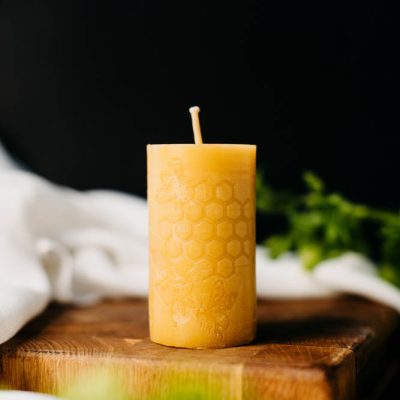

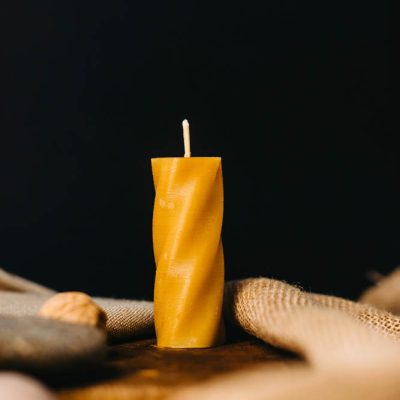
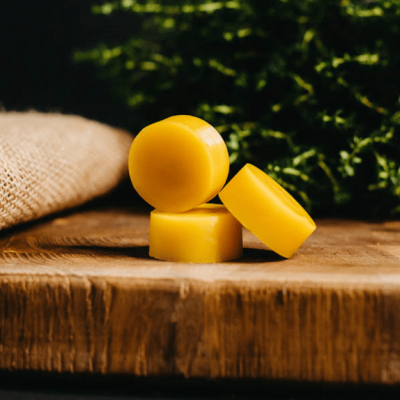





Beeswax container with lid. Suitable for storing food products (without specific aroma).
Did you know that beeswax is not just wax, but hard work?
 Bees do not collect wax from the field, but produce it themselves. Young worker bees expend a great deal of energy, which they obtain from honey, to produce tiny wax flakes with their bodies. To produce 1 kg of wax, a family hive consumes up to 8 kg of honey. Each small plate is carefully processed and perfectly crafted into a hexagonal shape, which serves as a cradle for the new generation, as well as a storage place for honey.It is also interesting that bees do not produce wax for storage, but only when it is needed to “build” honeycombs. Each wax cell is the result of precision, instinct and labour that nature has preserved for millions of years.
 Now, when you look at beeswax, know that it is not just a material. It is the history of bees.Why use beeswax candles and containers?
 Beeswax is used in the production of candles, decorative lanterns and tableware. This helps to reduce waste and increase the holistic use of bee products. It also reduces the need for imported materials (such as soy or palm wax, which can be associated with deforestation and intensive agriculture, which have a negative impact on the environment).Beeswax is a completely natural and 100% local material obtained directly from bees. Unlike paraffin, which is a petroleum derivative, beeswax is an environmentally friendly and renewable material.Beeswax candles purify the air by producing negative ions during combustion. These ions and the positive ions in the air (carried by dust particles, pollen, mould, bacteria, viruses and other allergens) form an ion bond. As a result, heavier particles fall to the ground instead of remaining in the air. This reduces the amount of allergens and pollutants in the air, helping to create cleaner and healthier indoor air.Beeswax candles give off a pleasant, natural and slightly sweet aroma. Unlike candles scented with artificial substances, the aroma of beeswax is not overpowering or intrusive.It smells like summer!
Can be washed in cold water.